Summer in Malta: a visitor’s guide to the daytime party scene
If you’ve spent any time in Malta between June and September, you’ll have noticed that the island’s social calendar runs on a slightly different rhythm than the rest of Europe. Yes, there’s the classic Paceville nightlife once the sun goes down — but the real local signature, the part that actually defines a Maltese summer, happens earlier in the day. Between roughly midday and 7 pm, the action moves to the water: rooftop pools across Sliema and St Julian’s, beach clubs along the northern coast, and a steady stream of catamarans and sailing boats heading out of the Sliema marina for the afternoon. For first-time visitors,check –> all pool party malta and on-water event scene can feel a bit overwhelming to navigate – you can check –> discover all boat party in malta.
Why Malta does daytime events so well
A few practical reasons. First, the climate is exceptionally stable between mid-May and mid-October: very little rainfall, temperatures that hover between 28 and 33°C in July and August, and sea water that reaches 25–26°C in peak summer. You can book an outdoor event three months in advance and be virtually guaranteed it won’t be rained off — something you can’t do in most other Mediterranean destinations.
Second, the geography is compact. The vast majority of Malta’s summer venues are concentrated along a 4–5 kilometre stretch from Sliema through St Julian’s to Paceville, plus the boat departures from Sliema marina. You don’t need a car. You don’t really need taxis either, as long as your accommodation is in this zone — most things are walkable, and Bolt covers the rest cheaply.
Third, the price point is genuinely good compared to Ibiza, Mykonos, or the Croatian coast. A full Saturday combining a boat trip in the afternoon and a beach club session in the early evening typically lands somewhere between £55 and £85 per person, which is substantially below what you’d pay for an equivalent day on a Spanish or Greek island.
Malta’s daytime pool events fall broadly into two categories, and it helps to understand which one you’re booking before you turn up.
Rooftop hotel pools. Several hotels in Sliema and St Julian’s have converted their top floors into proper venues with infinity pools, sun loungers, DJ setups, and bar service. The atmosphere is more lounge than rave — think house and tropical house in the early afternoon, with the energy gradually building toward sunset. Hugo’s Hotel in Paceville is the best-known of these and runs near-daily programmes in July and August. Entry is usually around £15–25 with one or two drinks included.
Standalone beach clubs. The most famous of these is Café del Mar at St Paul’s Bay, which imported the Ibizan model and has built its own Maltese identity around it. It’s larger than the rooftop venues, has a proper beach club layout with cabanas you can rent, and tends to programme bigger international DJs on Thursdays and Sundays. Entry sits around £20–35 depending on the day, and bottle service for groups runs from £180 upwards.
A few practical tips. Thursdays and Sundays are the strongest days across most venues. Weekends are busier but the music tends to be more mainstream; midweek you’ll get better DJs and a more chilled crowd. If you’re a group of more than six, booking a cabana or bed in advance is genuinely worth it — turning up at 3 pm without a reserved spot on a hot Sunday means standing for four hours.
The on-water scene: catamarans, sailing boats and party cruises
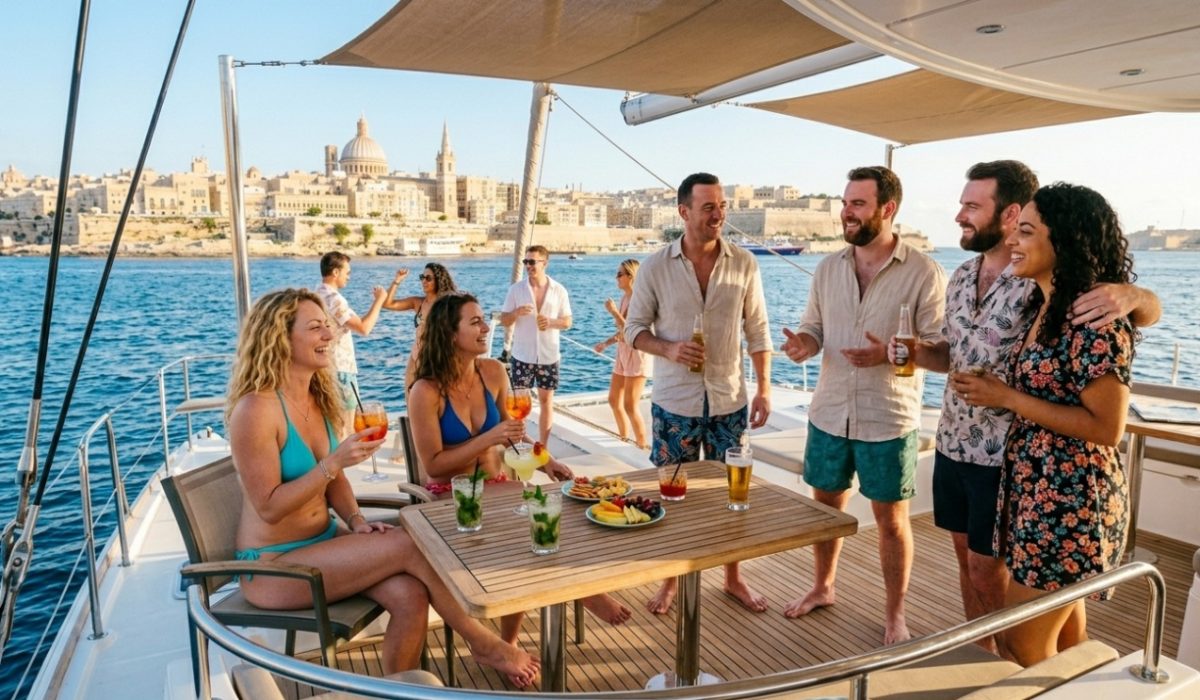
The other half of Malta’s daytime offering takes place out of Sliema’s Strand marina, with secondary departures from Bugibba and St Paul’s Bay. Operators run afternoon trips of 4–5 hours, typically leaving around 1 pm or 2 pm and returning at 6 or 7 pm. The standard itinerary is a loop towards Comino with a swim stop at the Blue Lagoon (one of the few ways to reach it without queueing for the public ferry, which gets brutal in August), a second stop at one of the smaller bays near Gozo, and a return along the coast.
The pricing tiers roughly break down as follows:
- Standard catamaran trips (80 to 150 passengers, basic bar, music): £35–50 per person
- Premium catamaran with included food and open bar: £60–80 per person
- Smaller boats with a “party” angle (DJ, more crowd-driven energy): £45–65 per person
- Private charter for groups of 8+ (full boat to yourselves): from £900–1,400 for the afternoon
When to come, when to avoid
Mid-June to early July is the sweet spot most regulars recommend. Sea temperatures are already warm, the programming is in full swing, and you avoid the peak August crowd. Late August to early September is the second sweet spot for similar reasons.
Mid-July and the first three weeks of August represent peak season. Music programming is at its best — most of the bigger DJ names pass through Malta during these weeks — but prices on accommodation jump by 30–40%, and venues are saturated. If you’re coming during this window, book everything (boat tickets, beach club beds, club tables) at least two weeks ahead.
Avoid: very early June (water still a bit cold for swimming, around 21°C) and late October onwards (most venues wind down their programming).
A practical Saturday template
For visitors looking for a good baseline day in summer, the most reliable template looks something like this:
- Morning until 1 pm: relaxed start, maybe a swim from one of the rocky beaches near Sliema or a quick visit to Valletta if you fancy some sightseeing first.
- 2 pm to 6 pm: afternoon boat trip out of Sliema marina, swim stop at the Blue Lagoon, return mid-evening.
- 6 pm to 8 pm: drinks and dinner along the Sliema promenade.
- 9 pm onwards: nightlife in Paceville if you have the energy, or a more relaxed wind-down at a rooftop bar.
You can run this template multiple times in a week with different boat operators and different rooftop venues — the experience varies enough that it doesn’t feel repetitive.
Final thoughts
Malta’s summer daytime scene is one of the most underrated parts of visiting the island. It’s compact enough that you can build a great day without much planning, affordable enough that you don’t feel ripped off, and reliable enough that you can plan it in advance without worrying about the weather. The main mistake first-timers make is treating it as an afterthought to the night life — in reality, the daytime is the better half of the offering, and most regulars structure their stay around the afternoons rather than the late nights.